Translate

Σάββατο 15 Μαρτίου 2014

                                           (http://www.quotestree.com/confucius-quotes.html)
Confucius (551–479 BC)[1] was a Chinese teacher, editor, politician, and philosopher of the Spring and Autumn period of Chinese history.
The philosophy of Confucius emphasized personal and governmental morality, correctness of social relationships, justice and sincerity. His followers competed successfully with many other schools during the Hundred Schools of Thought era only to be suppressed in favor of the Legalists during the Qin Dynasty. Following the victory of Han over Chu after the collapse of Qin, Confucius's thoughts received official sanction and were further developed into a system known as Confucianism.
Confucius is traditionally credited with having authored or edited many of the Chinese classic texts including all of the Five Classics, but modern scholars are cautious of attributing specific assertions to Confucius himself. Aphorisms concerning his teachings were compiled in the Analects, but only many years after his death.
Confucius's principles had a basis in common Chinese tradition and belief. He championed strong family loyalty, ancestor worship, respect of elders by their children and of husbands by their wives. He also recommended family as a basis for ideal government. He espoused the well-known principle "Do not do to others what you do not want done to yourself", an early version of the Golden Rule (http://en.wikipedia.org/wiki/Confucius)
                                             (http://www.rugusavay.com/alfred-nobel-quotes/)
Alfred Bernhard Nobel (Swedish pronunciation: [ˈɑlfred noˈbɛl] About this sound listen ; 21 October 1833 – 10 December 1896) was a Swedish chemist, engineer, innovator, and armaments manufacturer.
He was the inventor of dynamite. Nobel also owned Bofors, which he had redirected from its previous role as primarily an iron and steel producer to a major manufacturer of cannon and other armaments. Nobel held 350 different patents, dynamite being the most famous. His fortune was used posthumously to institute the Nobel Prizes. The synthetic element nobelium was named after him. His name also survives in modern-day companies such as Dynamit Nobel and AkzoNobel, which are descendants of or mergers with companies Nobel himself established. (http://en.wikipedia.org/wiki/Alfred_Nobel)


                                                       (http://izquotes.com/quote/281058)
Mustafa Kemal Atatürk (pronounced [musˈtäfä ceˈmäl ätäˈtyɾc]; 19 May 1881 (conventional) – 10 November 1938) was a Turkish army officer in the Ottoman military, revolutionary statesman, and the first President of Turkey. He is credited with being the founder of the Republic of Turkey. His surname, Atatürk (meaning "Father of the Turks"), was granted to him in 1934 and forbidden to any other person by the Turkish parliament.[1]
Atatürk was a military officer during World War I.[2] Following the defeat of the Ottoman Empire in World War I, he led the Turkish national movement in the Turkish War of Independence. Having established a provisional government in Ankara, he defeated the forces sent by the Allies. His military campaigns led to victory in the Turkish War of Independence. Atatürk then embarked upon a program of political, economic, and cultural reforms, seeking to transform the former Ottoman Empire into a modern, secular, and democratic nation-state. Under his leadership, thousands of new schools were built, primary education was made free and compulsory, and women were given equal civil and political rights, while the burden of taxation on peasants was reduced.[3] The principles of Atatürk's reforms, upon which modern Turkey was established, are referred to as Kemalism. (http://en.wikipedia.org/wiki/Kemal_Atat%C3%BCrk)


                                                      (http://favimages.net/image/122847/)
François-Marie Arouet (French: [fʁɑ̃.swa ma.ʁi aʁ.wɛ]; 21 November 1694 – 30 May 1778), known by his nom de plume Voltaire (pronounced: [vɔl.tɛːʁ]), was a French Enlightenment writer, historian and philosopher famous for his wit, his attacks on the established Catholic Church, and his advocacy of freedom of religion, freedom of expression, and separation of church and state. Voltaire was a versatile writer, producing works in almost every literary form, including plays, poems, novels, essays, and historical and scientific works. He wrote more than 20,000 letters and more than 2,000 books and pamphlets. He was an outspoken advocate, despite the risk this placed him in under the strict censorship laws of the time. As a satirical polemicist, he frequently made use of his works to criticize intolerance, religious dogma, and the French institutions of his day. (http://en.wikipedia.org/wiki/Voltaire)

       (http://thefabweb.com/79182/30-best-quotes-in-pictures-of-the-week-feb-10th-to-feb-16th-2013/)
Hypatia (/haɪˈpeɪʃə/ hy-PAY-shə; Ancient Greek: Ὑπατία; Hypatía) (born c. AD 350 – 370; died 415[2]) was a Greek Alexandrine Neoplatonist philosopher in Egypt who was one of the earliest mothers of mathematics.[3] As head of the Platonist school at Alexandria, she also taught philosophy and astronomy.[4][5][6][7]
As a Neoplatonist philosopher, she belonged to the mathematic tradition of the Academy of Athens, as represented by Eudoxus of Cnidus;[8] she was of the intellectual school of the 3rd century thinker Plotinus, which encouraged logic and mathematical study in place of empirical enquiry and strongly encouraged law in place of nature.[3]
According to the only contemporary source, Hypatia was murdered by a Christian mob after being accused of exacerbating a conflict between two prominent figures in Alexandria: the governor Orestes and the Bishop of Alexandria.[9] Kathleen Wider proposes that the murder of Hypatia marked the end of Classical antiquity,[10] and Stephen Greenblatt observes that her murder "effectively marked the downfall of Alexandrian intellectual life".[11] On the other hand, Maria Dzielska and Christian Wildberg note that Hellenistic philosophy continued to flourish in the 5th and 6th centuries, and perhaps until the age of Justinian.[12]
(http://en.wikipedia.org/wiki/Hypatia_of_Alexandria)
   (http://www.androidpit.com/en/android/market/apps/app/com.mbwasi.winston/Winston-Churchill-Quotes)
Sir Winston Leonard Spencer-Churchill, KG, OM, CH, TD, DL, FRS, RA (30 November 1874 – 24 January 1965) was a British politician who was the Prime Minister of the United Kingdom from 1940 to 1945 and again from 1951 to 1955. Widely regarded as one of the greatest wartime leaders of the 20th century, Churchill was also an officer in the British Army, a historian, a writer, and an artist. He is the only British Prime Minister to have won the Nobel Prize in Literature, and was the first person to be made an honorary citizen of the United States.
Churchill was born into the aristocratic family of the Dukes of Marlborough, a branch of the Spencer family. His father, Lord Randolph Churchill, was a charismatic politician who served as Chancellor of the Exchequer; his mother, Jennie Jerome, was an American socialite. As a young army officer, he saw action in British India, the Sudan, and the Second Boer War. He gained fame as a war correspondent and wrote books about his campaigns.
At the forefront of politics for fifty years, he held many political and cabinet positions. Before the First World War, he served as President of the Board of Trade, Home Secretary, and First Lord of the Admiralty as part of the Asquith Liberal government. During the war, he continued as First Lord of the Admiralty until the disastrous Gallipoli Campaign caused his departure from government. He then briefly resumed active army service on the Western Front as commander of the 6th Battalion of the Royal Scots Fusiliers. He returned to government as Minister of Munitions, Secretary of State for War, and Secretary of State for Air. After the War, Churchill served as Chancellor of the Exchequer in the Conservative (Baldwin) government of 1924–29, controversially returning the pound sterling in 1925 to the gold standard at its pre-war parity, a move widely seen as creating deflationary pressure on the UK economy. Also controversial were his opposition to increased home rule for India and his resistance to the 1936 abdication of Edward VIII.
Out of office and politically "in the wilderness" during the 1930s, Churchill took the lead in warning about Nazi Germany and in campaigning for rearmament. On the outbreak of the Second World War, he was again appointed First Lord of the Admiralty. Following the resignation of Neville Chamberlain on 10 May 1940, Churchill became Prime Minister. His steadfast refusal to consider defeat, surrender, or a compromise peace helped inspire British resistance, especially during the difficult early days of the War when Britain stood alone in its active opposition to Adolf Hitler. Churchill was particularly noted for his speeches and radio broadcasts, which helped inspire the British people. He led Britain as Prime Minister until victory over Nazi Germany had been secured.
After the Conservative Party lost the 1945 election, he became Leader of the Opposition to the Labour Government. After winning the 1951 election, he again became Prime Minister, before retiring in 1955. Upon his death, Elizabeth II granted him the honour of a state funeral, which saw one of the largest assemblies of world statesmen in history.[1] Named the Greatest Briton of all time in a 2002 poll, Churchill is widely regarded as being among the most influential people in British history, consistently ranking well in opinion polls of Prime Ministers of the United Kingdom. (http://en.wikipedia.org/wiki/Churchill,_Winston)


(http://livebyquotes.com/2013/i-am-not-afraid-of-an-army-of-lions-led-by-sheep-alexander-the-great/)
Alexander III of Macedon (20/21 July 356 – 10/11 June 323 BC), commonly known as Alexander the Great (Greek: Ἀλέξανδρος ὁ Μέγας, Aléxandros ho Mégasiii[›] from the Greek ἀλέξω alexo "to defend, help" + ἀνήρ aner "man"), was a king of the Greek kingdom of Macedon. Born in Pella in 356 BC, Alexander succeeded his father, Philip II to the throne at the age of twenty. He spent most of his ruling years on an unprecedented military campaign through Asia and northeast Africa, until by the age of thirty he had created one of the largest empires of the ancient world, stretching from Greece to Egypt and into present-day Pakistan.[1] He was undefeated in battle and is considered one of history's most successful commanders.[2]
During his youth, Alexander was tutored by the philosopher Aristotle until the age of 16. When he succeeded his father to the throne in 336 BC, after Philip was assassinated, Alexander inherited a strong kingdom and an experienced army. He had been awarded the generalship of Greece and used this authority to launch his father's military expansion plans. In 334 BC, he invaded the Achaemenid empire, ruled Asia Minor, and began a series of campaigns that lasted ten years. Alexander broke the power of Persia in a series of decisive battles, most notably the battles of Issus and Gaugamela. He subsequently overthrew the Persian King Darius III and conquered the entirety of the Persian Empire.i[›] At that point, his empire stretched from the Adriatic Sea to the Indus River.
Seeking to reach the "ends of the world and the Great Outer Sea", he invaded India in 326 BC, but was eventually forced to turn back at the demand of his troops. Alexander died in Babylon in 323 BC, the city he planned to establish as his capital,[3] without executing a series of planned campaigns that would have begun with an invasion of Arabia. In the years following his death, a series of civil wars tore his empire apart, resulting in several states ruled by the Diadochi, Alexander's surviving generals and heirs.
Alexander's legacy includes the cultural diffusion his conquests engendered. He founded some twenty cities that bore his name, most notably Alexandria in Egypt. Alexander's settlement of Greek colonists and the resulting spread of Greek culture in the east resulted in a new Hellenistic civilization, aspects of which were still evident in the traditions of the Byzantine Empire in the mid-15th century. Alexander became legendary as a classical hero in the mold of Achilles, and he features prominently in the history and myth of Greek and non-Greek cultures. He became the measure against which military leaders compared themselves, and military academies throughout the world still teach his tactics.[4]ii[›]
(http://en.wikipedia.org/wiki/Alexander_the_Great)


(http://willingtobegreek.wordpress.com/category/%CE%BA%CE%BF%CE%AF%CF%84%CE%B1-%CE%BD%CE%B1-%CE%B4%CE%B5%CE%B9%CF%82/page/8/)
Heraclitus of Ephesus (/ˌhɛrəˈklaɪtəs/;[1] Greek: Ἡράκλειτος ὁ Ἐφέσιος, Hērákleitos ho Ephésios; c. 535 – c. 475 BCE) was a pre-Socratic Greek philosopher, a native of the Greek city Ephesus, Ionia, on the coast of Asia Minor. He was of distinguished parentage. Little is known about his early life and education, but he regarded himself as self-taught and a pioneer of wisdom. From the lonely life he led, and still more from the riddling nature of his philosophy and his contempt for humankind in general, he was called "The Obscure" and the "Weeping Philosopher".
Heraclitus is famous for his insistence on ever-present change in the universe, as stated in the famous saying, "No man ever steps in the same river twice"[2] (see panta rhei, below). He believed in the unity of opposites, stating that "the path up and down are one and the same", all existing entities being characterized by pairs of contrary properties. His cryptic utterance that "all entities come to be in accordance with this Logos" (literally, "word", "reason", or "account") has been the subject of numerous interpretations. (http://en.wikipedia.org/wiki/Heraclitus)

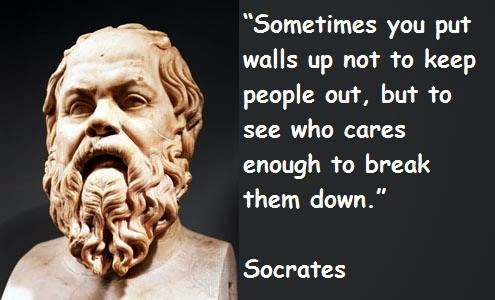
        (http://moco-choco.com/2013/10/10/collected-quotes-from-socrates/best_quotes_of_socrates_22/)
Socrates (/ˈsɒkrətiːz/;[2] Greek: Σωκράτης, Ancient Greek pronunciation: [sɔːkrátɛːs], Sōkrátēs; 470/469 BC – 399 BC)[1] was a classical Greek (Athenian) philosopher. Credited as one of the founders of Western philosophy, he is an enigmatic figure known chiefly through the accounts of later classical writers, especially the writings of his students Plato and Xenophon and the plays of his contemporary Aristophanes. Many would claim[weasel words] that Plato's dialogues are the most comprehensive accounts of Socrates to survive from antiquity.[3]
Through his portrayal in Plato's dialogues, Socrates has become renowned for his contribution to the field of ethics, and it is this Platonic Socrates who lends his name to the concepts of Socratic irony and the Socratic method, or elenchus. The latter remains a commonly used tool in a wide range of discussions, and is a type of pedagogy in which a series of questions is asked not only to draw individual answers, but also to encourage fundamental insight into the issue at hand. Plato's Socrates also made important and lasting contributions to the field of epistemology, and the influence of his ideas and approach remains a strong foundation for much western philosophy that followed. (http://en.wikipedia.org/wiki/Socrates)
                                                 (http://lmlrn.com/category/quotes-2/page/2/)
The Dalai Lama /ˈdɑːlaɪ ˈlɑːmə/[1][2] is a high lama in the Gelug or "yellow Hat" school of Tibetan Buddhism, founded by Tsongkhapa (1357–1419). The name is a combination of the Sino-Mongolic word dalai meaning "ocean" and the Tibetan word བླ་མ་ (bla-ma) meaning "guru, teacher, mentor".[3]
According to Tibetan dictionary, the Dalai Lama is the rebirth in a line of tulkus who are considered to be manifestations of the bodhisattva of compassion, Avalokiteśvara. The Dalai Lama is often thought to be the leader of the Gelug School, but this position belongs officially to the Ganden Tripa, which is a temporary position appointed by the Dalai Lama who, in practice, exerts much influence. The line of Dalai Lamas began as a lineage of spiritual teachers; the 5th Dalai Lama assumed political authority over Tibet.
For certain periods between the 17th century and 1962, the Dalai Lamas sometimes directed the Tibetan government, which administered portions of Tibet from Lhasa. The 14th Dalai Lama remained the head of state for the Central Tibetan Administration ("Tibetan government in exile") until his retirement on March 14, 2011. He has indicated that the institution of the Dalai Lama may be abolished in the future, and also that the next Dalai Lama may be found outside Tibet and may be female.[4] The Chinese government rejected this and asserted that only it has the authority to select the next Dalai Lama.[5] 
(http://en.wikipedia.org/wiki/Dalai_Lama)